

Full Name
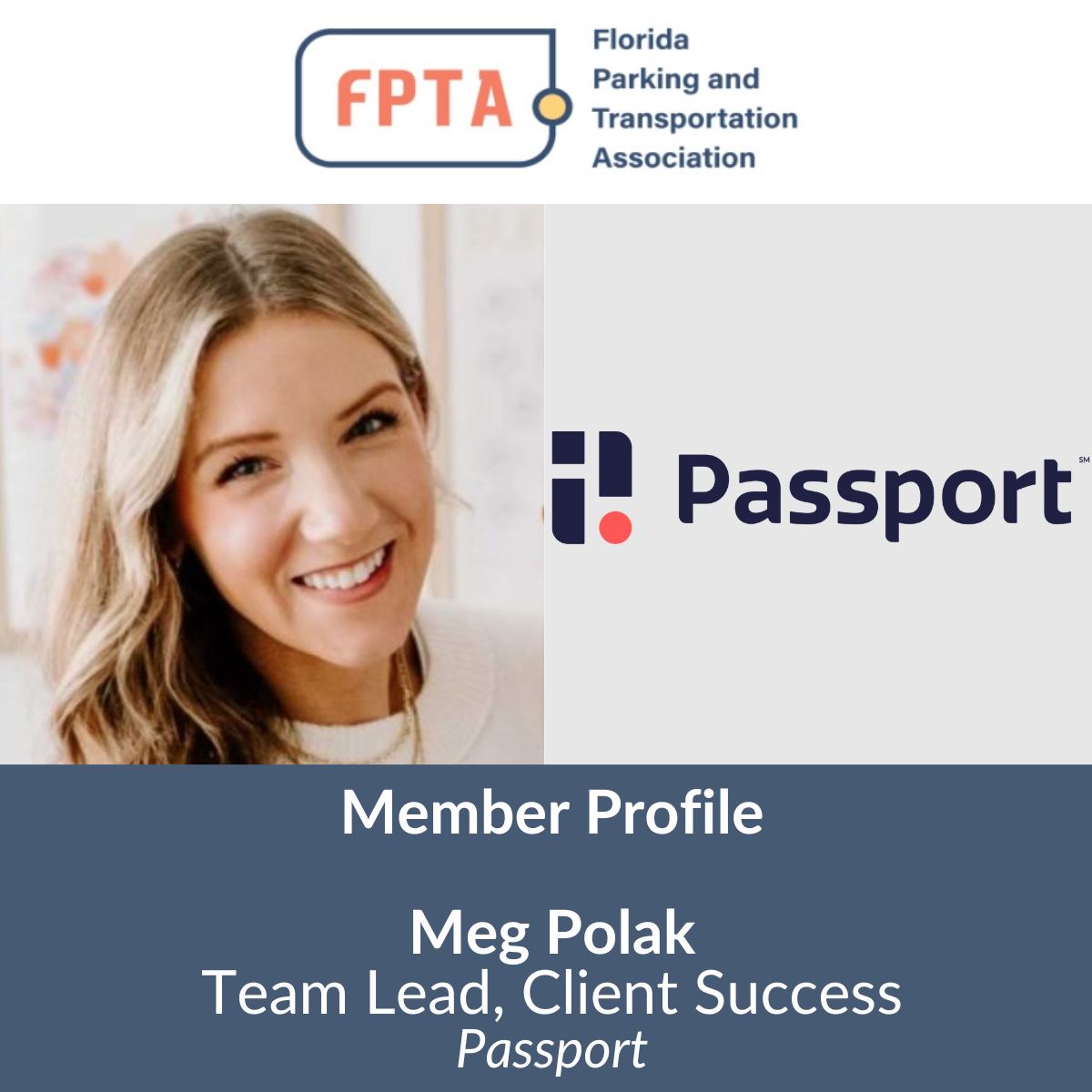
Meg Polak
Title
Team Lead, Client Success
Organization
Passport
What is your role and how does your organization contribute to parking, transportation, and mobility in Florida?
At Passport, we contribute to Florida’s mobility landscape by providing a unified digital operating system that modernizes how cities and universities manage their curb space. We empower municipalities by integrating mobile payments, digital permitting, and real-time enforcement into one cohesive platform. By replacing fragmented, manual processes with our data-driven solution, we help our partners reduce congestion, streamline financial operations, and create a more accessible, efficient, and livable environment for both residents and visitors.
As a Team Lead of Client Success at Passport, I serve as a strategic advisor for our clients and bridge the gap between our technical ecosystem and the operational reality of our clients. I act as both a consultant, guiding cities and universities to fully leverage our platform to solve their unique mobility challenges, and a leader for my team, leading from the front and coaching around being our clients' strategic partner.
What drew you to this industry, and what has kept you here?
Honestly, my path into this industry wasn't a grand plan. I knew I wanted to work for an innovative tech company in Charlotte, and I wanted to be in Client Success. Passport checked both of those boxes. The parking and mobility space was an unexpected path, and it's truly so much more complex than I ever thought it would be. I'm 7 years in and feel like I still have so much to learn!
What's kept me here is my team culture and our customer relationships. At Passport, I work with such a wide range of clients, municipalities, universities, parking operators across the country, and the work I do in Client Success directly impacts whether those communities have a better experience managing their operations. The role has kept evolving as I've moved into a team lead capacity, which has added a whole new dimension. Managing client success team members, thinking about process, and handling escalations at a higher level. The combination of client impact and team development is very rewarding!
How has being involved with FPTA benefited you or your organization?
FPTA has been really valuable on a couple of levels. The most direct benefit is the client relationships. I support several Florida-based clients, so being in the room at conferences creates a different kind of connection than a virtual meeting ever can. It's a chance to meet face to face, hear what's on their minds, and reinforce that Passport is genuinely invested in their success and in the Florida market specifically.
FPTA does a great job of creating a platform for these moments. Whether it's through the annual conference or the mid-year educational seminar, there's always a strong mix of peer learning and networking that I find really valuable. The focus on case studies and practical takeaways means I'm not just connecting with clients, I'm coming back with real insight into what agencies across the state are prioritizing and where the industry is headed.
That context makes me a better partner to my clients and helps me bring a more informed perspective back to our team.
How do you or your team stay engaged with the FPTA community throughout the year?
Passport sponsors FPTA, which I'm proud of, as it shows that we're genuinely committed to the Florida parking community.
I also try to get to the conference every year, which makes the sponsorship feel more personal.
What trends are shaping the future of parking and mobility in Florida right now?
There's a lot happening right now. The conversation around connected mobility and integrating systems for smarter travel is really picking up, and clients are thinking beyond just parking and asking how everything ties together. That's actually very aligned with what Passport does, so it's a trend we're well-positioned for.
Legislation is also on everyone's radar. The work FPTA did around HB 323 was a great example of the industry coming together to actually influence outcomes. That kind of advocacy matters, and I think it signals a more mature, organized industry than it was even a few years ago.
What’s one challenge the industry is facing, and one opportunity you’re excited about?
One of the bigger challenges we're navigating right now is the Florida DMV creating roadblocks around registered owner lookup information. For cities that rely on that data for parking enforcement, it creates real operational headaches and adds cost.
On the flip side, the opportunity I'm most excited about is dynamic curb management. The curb is becoming one of the most contested and valuable pieces of urban real estate out there. Ride share, delivery, transit, bike lanes, EV charging. Cities are starting to understand the need smarter tools to manage it in real time.
What role do data and analytics play in your decision-making today?
Data plays a huge role for me personally and for my clients. On my end, I'm constantly looking at account health scores, renewals, and client engagement to make sure I'm being proactive rather than reactive. The goal is to catch something before it becomes a problem, and you can only do that if you're paying attention to the right signals. It's shifted the way I manage my book of business pretty significantly.
On the client side, the expectations around data have completely changed. They're not just asking "is the system working?" anymore, they want real-time insights, better dashboards, and reporting that helps them make decisions and justify investments internally. Data has become a big part of how they tell their own story to city leadership and stakeholders.
Can you share a recent Florida project, initiative, or success story from your organization?
The perfect project to showcase would be this one: City of Sarasota Parking.
I work directly with Sarasota, so this is project coming to fruition was rewarding to see!
What’s something the industry often overlooks that deserves more attention?
I think workforce development and professional growth are so important. We spend a lot of time talking about technology, and rightfully so, but the people who have to implement, manage, and make sense of all that technology sometimes get left out of the conversation. As our systems get more sophisticated, the gap between what the tools can do and what teams are trained to do can widen pretty quickly without intention.
The other thing I'd add is policy. Technology moves fast, and policy moves slow, and that disconnect is a real problem. We've seen it play out with things like automated enforcement and curb management. The tools exist, they work, but the regulatory environment hasn't caught up.
What innovations or changes are you most excited to see in the near future?
AI and automation are at the top of my list. We're really just scratching the surface of what's possible there. The idea that a city could have a real-time, predictive picture of what's happening across their entire parking and mobility operation, and actually use that to make smarter decisions about pricing, curb allocation, and enforcement prioritization is so interesting.
From a Client Success perspective, I'm also excited about what automation means for how we support clients. The more we can surface the right insights at the right time, the more proactive and impactful those conversations become. It shifts the relationship from reactive problem-solving to genuine strategic partnership, which is ultimately what I want for every client I work with.