

FPTA Member Profile: Broxton Harvey, City of Sarasota
We are excited to introduce a new initiative for FPTA this year: the FPTA Member Profile Series. Our association comprises an incredible community of parking, transportation, and mobility professionals with unique backgrounds, experiences, and perspectives, and we are proud to spotlight the people who help shape our industry.
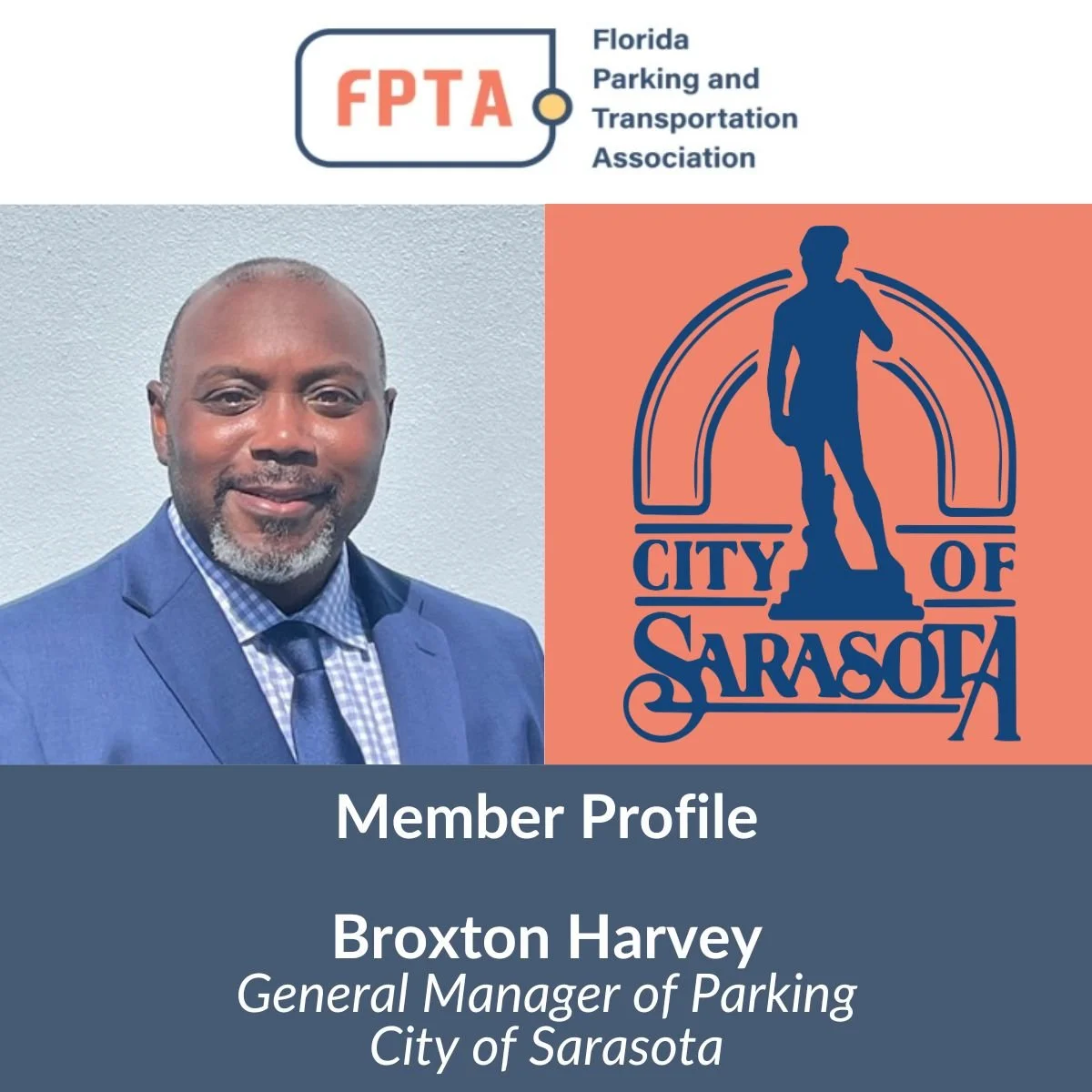
Our first featured member is Broxton Harvey, General Manager of Parking for the City of Sarasota. Take a moment to learn more about Broxton’s path into the industry, his involvement with FPTA, his thoughts on the future of parking and mobility, and more.
Full Name
Broxton Harvey
Title
General Manager of Parking
Organization
City of Sarasota
What is your role and how does your organization contribute to parking, transportation, and mobility in Florida?
Role is General Manager of Parking for the City of Sarasota. The position oversees 9,000 parking spaces throughout the city with a mix of paid on-street, timed, city owned lots, garages, and residential parking. In Sarasota, the Parking Division is focused on leveraging technology to bring forth new and innovative parking solutions to our citizens and customers.
Since my arrival we have expanded the paid parking program both physically and through the use of technology. Customers now have the ability to perform all functions of parking from the convenience of their phone. Whether they are paying for a parking session, purchasing a permit online, or paying a citation, all of these functions are at their finger tips with the click of a button.
The Parking Division has also moved to a gateless parking solution with the help of fixed license plate recognition that has significantly reduced the traffic congestion at points of ingress and egress. This is especially helpful during our special events, where traffic flow has improved significantly. Sarasota's Parking Division takes pride in being on the cutting edge of technological advances and bringing a seamless, safe, and efficient parking experience to all that visit our great city.
What drew you to this industry, and what has kept you here?
I started out working in parking first in the valet parking hotel industry. Seeing how parking was significantly tied to the user experience, it gave me a desire to improve upon operational challenges whenever the arose. This took form in many fashions, but mainly in the creating and updating of standard operating procedures. We strived to provide every guest with an exemplary experience and this all began by ensuring that all staff were trained correctly and in the same manner. I realized that in parking we are truly the first impression and the last impression. This mindset has followed me from the private sector to now working in a municipality. While a great profit and loss statement is key to operating a thriving parking program, we should not forget that customer service and guest experience are tools as well that should be used to measure how successful a program has become.
What does a typical day look like in your role?
An average day consists of working with various local and state departments regarding parking operations. From Engineering, Procurement, IT, FDOT, DMV and Public Works I work to maintain an open line of communication by meeting often to address citywide parking operations. Then communicate with my management team to engage with our parking vendors to ensure smooth and uninterrupted service for our parkers. This may take form in email communications, in-person meetings, online meetings, or phone call. All in effort to be proactive instead of reactive.
My day also involves speaking with customers that may wish to address concerns that have been escalated to my level. I try to view parking from the lens of the user and take constructive comments and mold it into potential solutions in an attempt to improve upon operational challenges. Lastly, I engage with our key stakeholders to ensure they are aware of changes that may be on the horizon that may affect their businesses, tourism, and parking availability. These conversations and meetings are key to maintaining long and flourishing relationships within the community.
How has being involved with FPTA benefited you or your organization?
FPTA provides opportunities for open dialogue and networking platforms that assist with providing solutions within the parking industry.
What is your favorite part about being a member of FPTA?
At FPTA, we are indeed not just an organization, but a family. FPTA members are all about working together, problem solving, and creating solutions.
How do you or your team stay engaged with the FPTA community throughout the year?
I stay engaged with the FPTA community on a monthly basis by reaching out to members to bounce ideas and asking for constructive criticism and feedback. Most of the time, I can find someone that either has the same issue or had the same issue and has found a way to work through it. This type of networking is very beneficial to parking professionals. FPTA truly cares about their members and the success of the parking and transportation industry.
What trends are shaping the future of parking and mobility in Florida right now?
Data Collection and consolidation of vendor platforms.
What’s one challenge the industry is facing, and one opportunity you’re excited about?
One challenge is that NLET's is not allowing our vendors to utilize the ORI number to lookup driver information. This is now forcing use to integrate with DMV, which now is charging $.50 per lookup which no one has budgeted for this year. Looking for a solution. And one opportunity I am looking forward to is providing Sarasota parkers with real time on-street occupancy. This information will be viewed either on the city's website or via app. This will assist with drivers knowing where the open spaces are before reaching their destination.
How is technology changing the way you approach parking and transportation?
Technology is key to providing efficient parking. While we cannot get away from hardware altogether, the use of apps and software technological advances are quickly reshaping the way parking professionals do business.
What role do data and analytics play in your decision-making today?
Having true and efficient data shapes the way that I approach parking solutions. Data is key to making informed decisions regarding rates, hours, and staffing levels. Data and analytics can be used to tell a story when engaging stakeholders and government officials.
What makes Florida’s parking and mobility landscape unique compared to other regions?
So many different municipalities with paid parking programs from various sizes, yet will all one common goal.
Can you share a recent Florida project, initiative, or success story from your organization?
Implemented online appeals process. First on-line appeals were in person only, but this effected customers from out of town. Being fair and transparent is key, so on-line provides all customers the ability to express their concerns regarding a citation.
How are you addressing seasonal demand, tourism, or special events in your operation?
The ability to utilize seasonal demand gave me the necessary data needed when recommending the extension of paid parking hours in the city of Sarasota.
What’s one strategy or best practice that has made a measurable impact for your organization?
Staying engaged with FPTA conferences and events. These events are designed to inspire and motivate parking technological advances and best practices that assist in keeping operations up to date.
What advice would you give to others facing similar challenges in the industry?
Facing challenges, if not already a member join FPTA and stay engaged. If already a member, stay connected and attend conferences regularly. Technology is changing so swiftly, that within months a new integration or development may have presented itself that can solve your possible issue.
What’s something the industry often overlooks that deserves more attention?
Possibly focus more on the transportation aspect. In Sarasota, the Parking Division is responsible for more than parking. I over see the Bay Runner trolley that is partially funded by a state grant. And I also manage the city's contract with micromobility. I have noticed that transportation routes and micromobility is limited, with the exception of autonomous vehicles.
Where do you see the parking and mobility industry in the next 5-10 years?
I see our industry focusing more on city planning and design regarding infrastructure and parking layout and availability. Currently, Parking is considered a complex, yet necessary piece in most development discussions. As our parking professionals become more involved and informed about requirements and parking minimums, we are able to engage the key stakeholders like community groups, developers, construction companies, government officials, and investors on a more elevated level.
What innovations or changes are you most excited to see in the near future?
I see our industry focusing more on city planning and design regarding infrastructure and parking layout and availability. Currently, Parking is considered a complex, yet necessary piece in most development discussions. As our parking professionals become more involved and informed about requirements and parking minimums, we are able to engage the key stakeholders like community groups, developers, construction companies, government officials, and investors on a more elevated level.
If you could solve one industry challenge overnight, what would it be?
The one industry challenge I would solve where we are seeing a decline in demand for parking. This has been noticed since the pandemic due to work from home schedules and increase in ride share usage.
