

FPTA Member Profile: Ryan Bonardi, Director of Sales, Blinkay USA
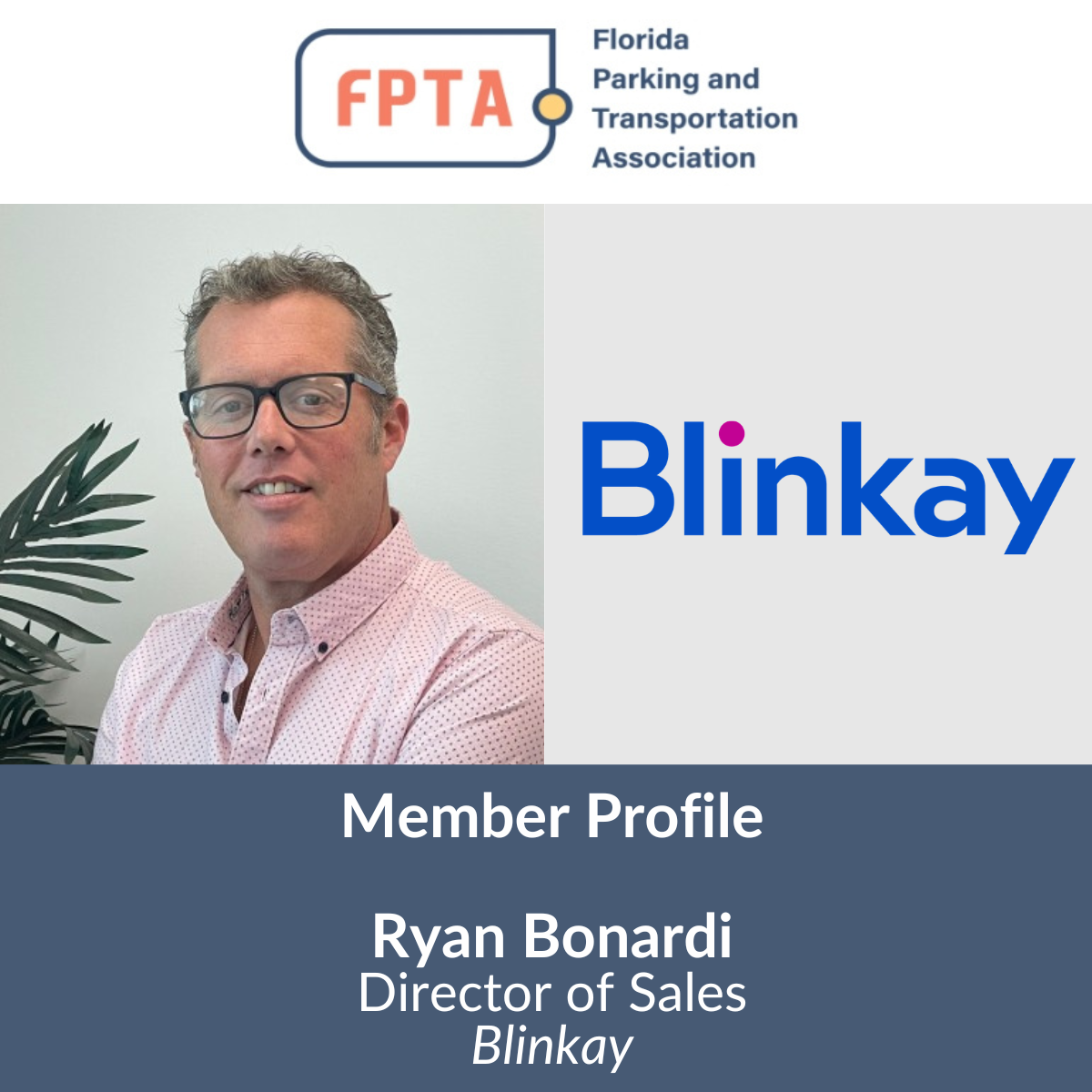
Full Name
Ryan Bonardi
Title
Director of Sales
Organization
Blinkay USA
What drew you to this industry, and what has kept you here?
Before I get into the more serious answer, I’ll be honest—my path into parking wasn’t exactly planned. I started my career selling insurance and investment products right out of college, and over time it became very repetitive. Doing the same thing day in and day out, and selling something where the benefit might not be realized for years, started to feel a bit mundane. A family friend suggested I’d be a good fit for a role with Schlumberger eCity, and that’s what opened the door for me into the parking industry—the rest is history. I was drawn to the parking industry because it sits at the intersection of technology, public policy, and real-world problem-solving. It’s one of those spaces that most people don’t think about—until it doesn’t work. That creates a real opportunity to make a meaningful impact.
What’s kept me here is the constant evolution. Parking has transformed from meters and tickets into a critical component of smart city infrastructure. Today, we’re talking about AI, automation, mobility ecosystems, and customer experience in ways that simply didn’t exist before.
It’s also a relationship-driven industry. You’re working with cities, operators, and stakeholders who are trying to solve real challenges for their communities. Being part of that—helping them move from legacy systems to modern, efficient solutions—is both challenging and rewarding.
How has being involved with FPTA benefited you or your organization?
Being involved with FPTA has been extremely valuable both personally and for Blinkay as an organization. At a high level, it provides a platform to stay closely connected to the unique challenges and priorities facing Florida’s transportation and parking community.
For me, it’s about access to meaningful conversations with peers—municipal leaders, operators, and industry partners—who are all working through similar issues. Those discussions help shape how we approach solutions, ensuring we’re not just bringing technology to the table, but delivering something that’s practical and aligned with real-world needs.
From an organizational standpoint, FPTA allows Blinkay to build trusted relationships within the Florida market. It gives us the opportunity to share what we’re doing, learn from others, and position ourselves as a long-term partner rather than just a vendor.
Equally important, it keeps us grounded. Being involved in FPTA ensures we’re listening as much as we’re presenting, which ultimately leads to better outcomes for the communities we serve.
How is technology changing the way you approach parking and transportation?
Technology has fundamentally reshaped how we approach parking and transportation, and I’ve had a front-row seat to that evolution over the course of my career.
When I first entered the industry, one of the biggest challenges was simply getting people to understand and accept the shift from single-space meters to multi-space meters. That was a major leap at the time. Not long after, we introduced pay-by-phone, which again required education and behavior change, but ultimately became a standard expectation.
From there, we saw off-street operations begin to move away from being 100% gate-controlled toward more flexible, meter-based and digital systems. At the same time, enforcement evolved with the introduction of mobile LPR, which significantly improved efficiency and coverage.
Today, we’re seeing the next major transformation with fixed LPR, real-time data integration, and the rise of frictionless parking—where everything is becoming license plate-based. The focus has shifted from hardware and transactions to automation, user experience, and data-driven operations.
What’s next? I don’t think anyone has that answer fully figured out yet—but that’s what makes this industry so interesting. The pace of change continues to accelerate, and I’m excited to be part of it—learning, adapting, and helping bring the next generation of solutions to market.
Can you share a recent Florida project, initiative, or success story from your organization?
One of our most impactful recent projects in Florida has been our work with the Miami Parking Authority (MPA) and the Miami Marlins to modernize event parking operations around loanDepot Park. The goal was to address long-standing challenges of congestion, inefficient entry and exit, and revenue leakage—especially during high-volume game days, when traditional gated systems created delays and frustration for fans.
Together, we implemented a gate-free, license plate-based parking system that allows vehicles to enter and exit garages without stopping. By using License Plate Recognition (LPR) technology as the primary credential, we eliminated the need for tickets, cashiers, and physical validation. Fans can prepay, use mobile apps, or scan a QR code on-site to complete payment, creating a much more flexible and user-friendly experience.
Behind the scenes, the system integrates real-time LPR data with parking payment platforms to ensure compliance and accountability. If a vehicle parks without payment, the system can identify it and initiate a follow-up process, significantly reducing revenue leakage while minimizing the need for manual enforcement. This approach allows operators to maintain control while shifting toward a more automated, data-driven model.
The result has been a true “frictionless parking” experience—faster ingress and egress, improved customer satisfaction, and stronger revenue capture. It’s a great example of how technology can transform event parking from a bottleneck into a seamless part of the overall fan experience, and it’s a model we see continuing to expand across Florida and beyond.
What’s something the industry often overlooks that deserves more attention?
One thing the parking industry often overlooks is the human behavior side of parking—how people actually interact with the system in real time.
We spend a lot of time focusing on technology, hardware, and enforcement strategies, but not always enough on how intuitive the experience is for the end user. If a system isn’t easy to understand—whether it’s signage, payment options, or rules—compliance drops, frustration increases, and enforcement becomes more difficult than it needs to be. In many cases, what looks like “non-compliance” is really confusion.
I also think the industry sometimes underestimates how quickly expectations are changing. People are used to seamless digital experiences in every other part of their lives—parking is no exception. The shift toward frictionless, license plate-based systems and automated enforcement is really about meeting those expectations while improving operational outcomes.
At the end of the day, the biggest opportunity isn’t just better technology—it’s aligning technology with behavior, data, and experience in a way that makes parking easier for everyone involved.
What innovations or changes are you most excited to see in the near future?
What excites me most is the continued shift toward fully integrated, frictionless parking systems.
We’re moving away from hardware-heavy models to license plate-based, data-driven operations, where LPR and AI can automate enforcement, improve compliance, and reduce manual effort. That’s a big leap in efficiency for operators.
On the customer side, the move toward frictionless experiences—where you can park and go without thinking about payment—is going to redefine expectations. The challenge, and opportunity, is delivering that convenience while still maintaining accountability.
