

FPTA Member Profile: William MacDonald, Director of Parking, City of Miami Beach
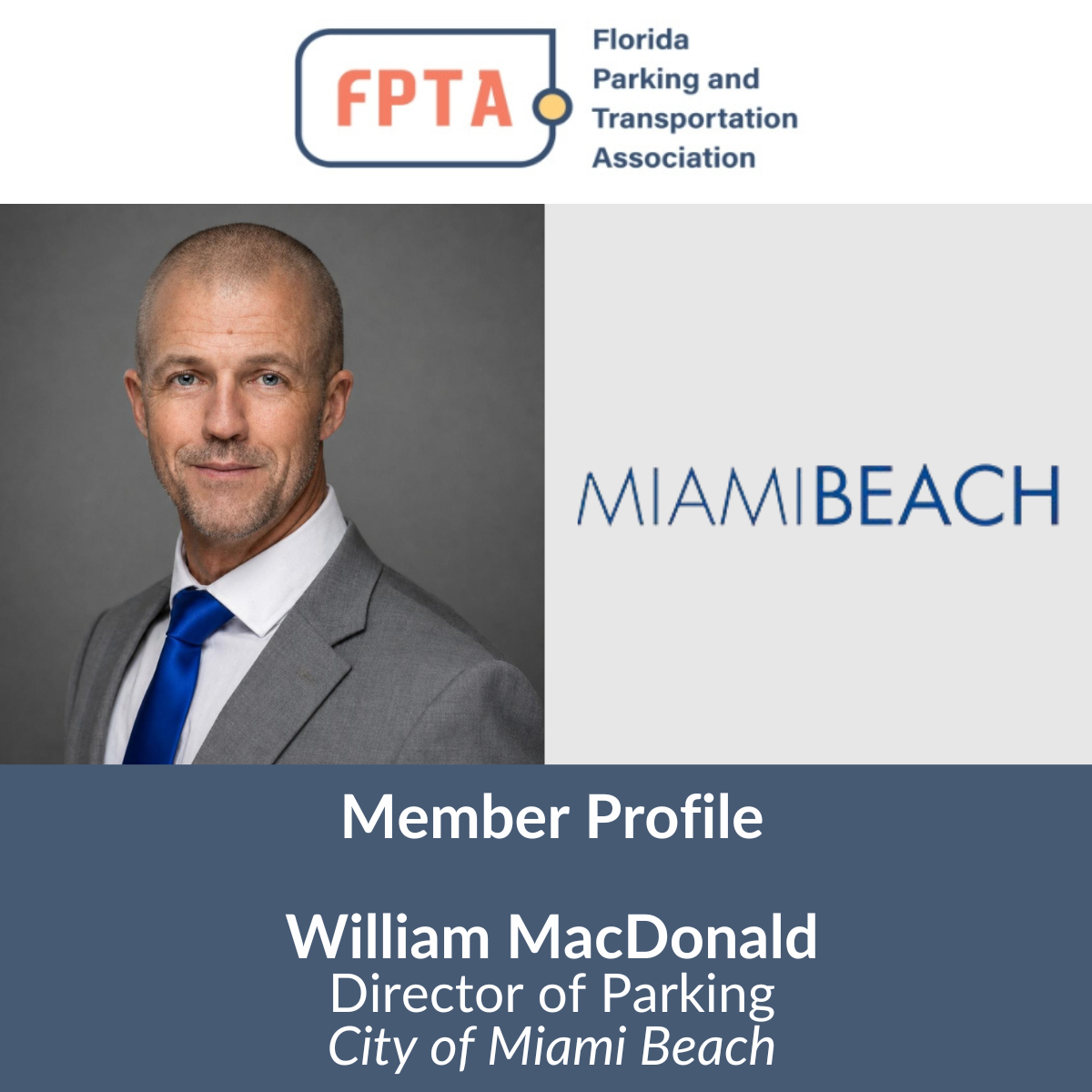
Full Name
William MacDonald
Title
Director of Parking
Organization
City of Miami Beach
What drew you to this industry, and what has kept you here?
What drew me to this industry was my transition out of the United States Army, where I was looking for a fast-paced operational environment. I began my career as a valet operations manager for a private parking company, and from there my curiosity for the industry quickly grew. I expanded into hotel valet operations, garages, and healthcare parking, gaining experience across multiple areas of the private sector.
As my career progressed, I developed a stronger interest in the broader parking and transportation ecosystem, which led me into the municipal side with the Department of Transportation for the City of Pasadena. Since then, my career has continued to grow as I’ve focused on solving the complex puzzle of parking and transportation operations within dense urban environments.
How has being involved with FPTA benefited you or your organization?
Being involved with FPTA has benefited both myself and our organization by allowing us to connect with other industry professionals facing many of the same operational challenges. There’s an old saying that plagiarism is the greatest form of flattery, and in many ways the parking and transportation industry grows stronger when agencies share ideas, collaborate, and learn from one another. Open communication within the industry helps all of us continue moving forward and identify best practices that work within our own unique environments.
How is technology changing the way you approach parking and transportation?
I believe technology is the most incredible lever in the parking and transportation industry today. It gives organizations the ability to become true force multipliers in how we enforce regulations, communicate with customers, collect revenue, analyze operations, and make data-driven decisions. Technology has transformed parking from a reactive industry into a proactive one.
For me personally, technology has changed the way I approach parking operations by allowing us to focus more on efficiency, customer experience, and strategic decision-making rather than simply manual processes. From license plate recognition and automated enforcement to real-time data analytics and modern parking management systems, technology allows us to operate smarter, respond faster, and better manage the growing complexities of dense urban environments.
Can you share a recent Florida project, initiative, or success story from your organization?
One of the best examples of how we are addressing seasonal demand and special events was during this past spring break. For the first time, the City utilized pricing as a tool to help drive parking behavior within the high-impact special event area. We increased on-street parking rates to $20 per hour while offering a convenient flat rate of $40 for 24-hour parking in our municipal garages.
The goal was to preserve curb availability for residents, who pay just $1 per hour, as well as individuals with mobility needs, while encouraging longer-term visitors to utilize the garages instead of circling for curbside parking. The results exceeded expectations. Even during peak demand periods, most block faces within the impacted area continued to have a few spaces available, demonstrating that more visitors were choosing garage parking.
This approach helped reduce congestion, minimize vehicles circling for parking, and improve curb access for residents and visitors who truly needed close proximity parking. It became a strong blueprint for how pricing and operational strategy can work together to better manage demand during major events and peak tourism periods.
What’s one strategy or best practice that has made a measurable impact for your organization?
One strategy that has made a measurable impact for the organization has been focusing heavily on servant leadership paired with accountability and consistency. I believe employees perform at their best when leadership is visible, supportive, and willing to work alongside the team while still maintaining clear expectations.
For me, servant leadership means giving employees the tools, training, and support they need to succeed, while also holding everyone to the same standard. Consistency is critical. When teams know expectations are fair, clear, and consistently enforced, it builds trust and creates a stronger culture.
That approach has led to better operational consistency, stronger teamwork, and improved performance across the organization. In my experience, culture and leadership ultimately drive long-term success even more so than policies or technology.
If you could solve one industry challenge overnight, what would it be?
If I could solve one industry challenge overnight, it would be infrastructure adaptation during the transition from car-dependent cities to multimodal cities. Across the country, cities are trying to balance vehicle traffic, micro mobility, transit, pedestrians, freight loading, bike lanes, rideshare activity, and on-street parking, all within the same limited roadway footprint. As urban density increases, that pressure only intensifies.
The reality is that the shift toward micro mobility and alternative transportation is not just a transportation change, it is a cultural change. And during that transition period, cities are forced to operate in two worlds at once: one still heavily reliant on vehicles, and another pushing toward reduced car dependency. That creates friction, congestion, curb competition, and growing pressure on parking and public space.
Solving that infrastructure challenge would allow cities to move toward the future in a way that is safer, more efficient, and less painful for residents, businesses, and visitors alike.
