

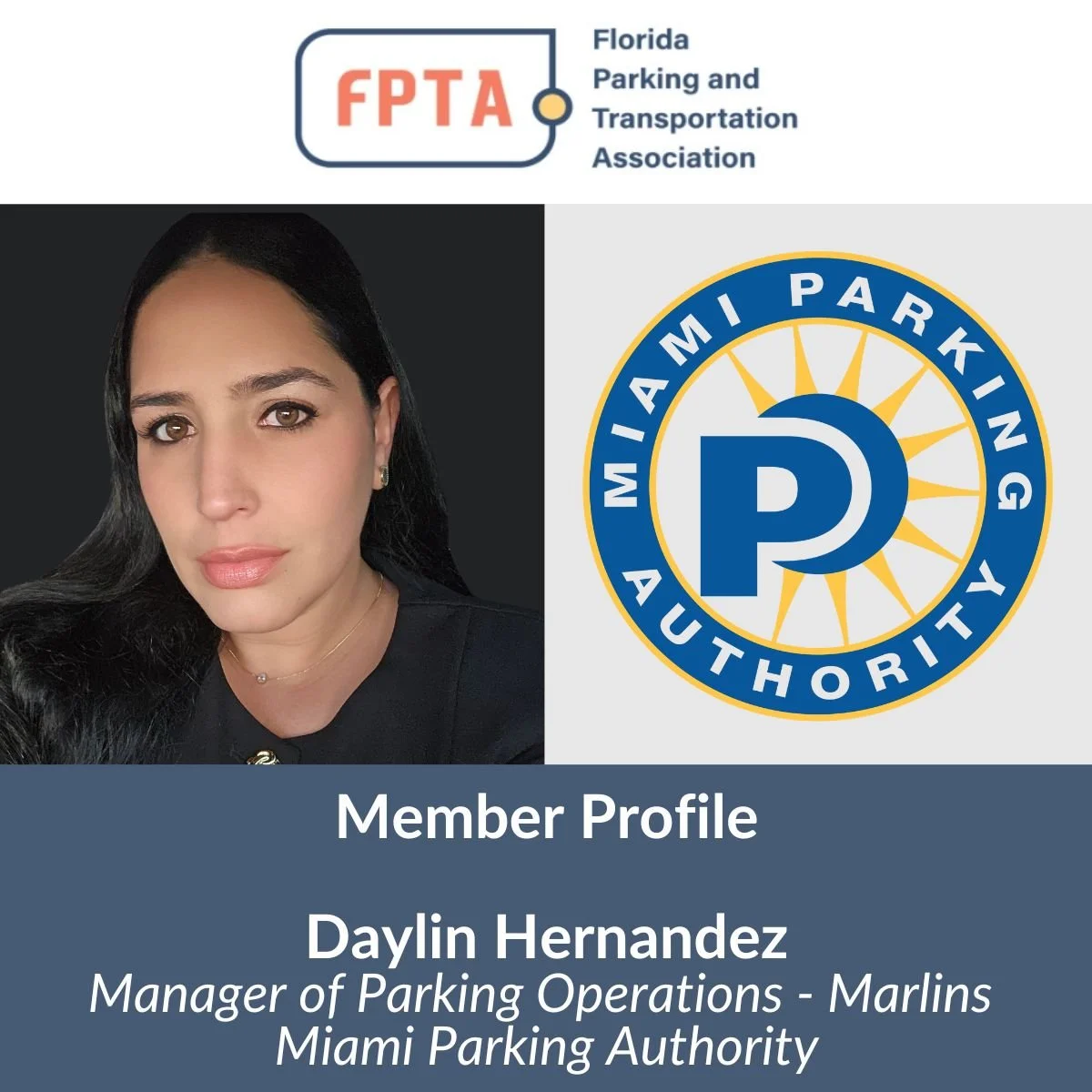
FPTA Member Profile: Daylin Hernandez, Miami Parking Authority
Full Name
Daylin Hernandez
Title
Operations Manager
Organization
Miami Parking Authority
What is your role and how does your organization contribute to parking, transportation, and mobility in Florida?
Supervision of parking operations at Marlins location within the Enforcement Division: Work includes effective supervision in planning, designing, installation, maintenance and/or enforcement of on street and off-street parking regulations as well as maintaining excellent customer relations with the public, City departments, and other agencies.
What drew you to this industry, and what has kept you here?
I’ve always been interested in positions where organization, problem-solving, and public interaction come together, and MPA field offers exactly that. Over time, what has kept me here is the sense of responsibility and purpose—knowing that my work helps maintain order, safety, and accessibility for everyone. I also value the constant learning and the chance to improve processes while building strong relationships with the public and colleagues.
What does a typical day look like in your role?
A typical day in my role as an operations Manager starts with reviewing operational reports, staffing levels, and any issues from the previous shift to ensure continuity. I coordinate daily assignments for field staff, making sure parking enforcement operations are properly staffed. Throughout the day, I monitor performance, address operational challenges in real time, and respond to issues from the public or other departments.
I also spend time supporting supervisors and team members, ensuring they have the resources and guidance needed to perform effectively. A key part of my role is maintaining compliance with parking regulations while also ensuring strong customer service and positive public interaction. In addition, I handle administrative responsibilities such as reporting, data review, and process improvements to help optimize operations. Every day requires balancing planning, leadership, and quick problem-solving.
How has being involved with FPTA benefited you or your organization?
Being involved with FPTA has been very beneficial both for me and for my organization. It has provided valuable opportunities for networking with other professionals in the parking and transportation industry, allowing us to share best practices and learn from the experiences of other agencies.
For me personally, FPTA has helped me stay current on industry trends, policies, and innovations that can be applied to improve our operations. For my organization, the knowledge and resources gained through FPTA have supported better decision-making, improved operational efficiency, and strengthened our approach to customer service and enforcement strategies. Overall, it has been a valuable platform for professional growth and continuous improvement.
How do you or your team stay engaged with the FPTA community throughout the year?
My team and I stay engaged with the FPTA community throughout the year by actively participating in conferences, workshops, and training sessions. We also make it a point to attend regional meetings and networking events whenever possible, which helps us stay connected with other professionals in the industry.
In addition, we stay involved by sharing information and best practices learned through FPTA with our staff, so the knowledge benefits the entire organization. We also maintain communication with other members and agencies to exchange ideas, discuss challenges, and stay updated on new developments in parking and transportation management. This ongoing engagement helps us remain informed, collaborative, and continuously improving our operations.
What trends are shaping the future of parking and mobility in Florida right now?
Right now, in Florida—especially in high-demand cities like Miami—parking and mobility are changing fast due to growth, technology, and shifting transportation habits. Here are the key trends shaping the industry:
One of the biggest trends is smart curb management and digital enforcement. Cities are using tools like cameras, sensors, and license plate recognition to better manage curb space, reduce congestion, and improve compliance. Miami, for example, is already piloting smart loading zones to manage deliveries and reduce traffic in busy areas.
Another major trend is the rise of dynamic and data-driven parking systems. Instead of fixed rules and pricing, operators are using real-time data and AI to adjust parking availability and pricing based on demand. This helps reduce congestion and improves efficiency in high-traffic areas.
We are also seeing a strong shift toward EV infrastructure and sustainability, with more EV charging stations being required in new developments and integrated into public parking facilities. This is driven by the rapid growth of electric and hybrid vehicles across Florida.
In addition, curbside has become a high-value mobility asset, not just for parking but also for deliveries, rideshare pick-ups, and micro-mobility services. This is pushing cities to rethink how curb space is allocated and monetized.
Finally, automation and digital enforcement technologies like LPR systems and mobile payment platforms are becoming standard, helping agencies improve compliance, reduce manual enforcement, and operate more efficiently.
Overall, the future of parking and mobility in Florida is moving toward a more connected, data-driven, and multi-use system that supports both urban growth and improved customer experience.
What’s one challenge the industry is facing, and one opportunity you’re excited about?
One major challenge the parking and mobility industry is facing right now is balancing growing demand with limited curb and parking space. In fast-growing areas like Florida, especially cities such as Miami, there are more vehicles, more deliveries, and more ride-share activity competing for the same curb space. This creates congestion, enforcement challenges, and pressure to constantly adapt policies and operations while still maintaining a positive customer experience.
At the same time, one exciting opportunity is the rise of smart mobility and data-driven parking management. New technologies such as real-time occupancy data, digital permitting, and automated enforcement tools are giving agencies the ability to manage curb space much more efficiently than before. This opens the door to better decision making, improved traffic flow, and more flexible use of curb space for things like deliveries, transit, and micro-mobility.
How is technology changing the way you approach parking and transportation?
In parking operations, tools like license plate recognition (LPR), mobile enforcement systems, and digital permitting have streamlined enforcement and reduced the need for manual processes. This allows teams to cover more area effectively while improving accuracy and consistency.
We also rely more on real-time data and analytics to understand parking demand, identify problem areas, and make informed decisions about staffing, enforcement priorities, and policy adjustments. This shift helps us move from reactive management to more proactive planning.
On the customer side, mobile payment apps and digital platforms have improved the user experience by making parking more convenient and reducing friction for the public. People can now find, pay, and extend parking sessions directly from their phones.
What role do data and analytics play in your decision-making today?
Data and analytics play a central role in my decision-making today. They help move operations from reactive to proactive by providing clear insight into what is happening in the field in real time and over longer trends.
I use data to monitor key performance indicators such as citation activity, compliance levels, coverage in enforcement areas, and response times. This allows me to identify patterns, spot inefficiencies, and adjust staffing or deployment strategies as needed to improve overall performance.
Analytics also support planning and resource allocation. For example, historical data helps determine where enforcement demand is highest, which areas may need additional attention, and how to optimize routes and schedules for field staff.
In addition, data is essential for transparency and accountability. It supports reporting to leadership and coordination with other departments, ensuring that decisions are backed by facts rather than assumptions. Overall, data and analytics are critical tools that improve efficiency, service quality, and strategic planning in daily operations.
What makes Florida’s parking and mobility landscape unique compared to other regions?
Data and analytics play a central role in my decision-making today. They help move operations from reactive to proactive by providing clear insight into what is happening in the field in real time and over longer trends.
I use data to monitor key performance indicators such as citation activity, compliance levels, coverage in enforcement areas, and response times. This allows me to identify patterns, spot inefficiencies, and adjust staffing or deployment strategies as needed to improve overall performance.
Analytics also support planning and resource allocation. For example, historical data helps determine where enforcement demand is highest, which areas may need additional attention, and how to optimize routes and schedules for field staff.
In addition, data is essential for transparency and accountability. It supports reporting to leadership and coordination with other departments, ensuring that decisions are backed by facts rather than assumptions. Overall, data and analytics are critical tools that improve efficiency, service quality, and strategic planning in daily operations.
Can you share a recent Florida project, initiative, or success story from your organization?
One recent success story from our organization is the continued expansion of digital parking payment and smart mobility tools to improve the customer experience and overall curb management. For example, the implementation and expansion of mobile payment platforms in Miami have significantly improved convenience for users while also enhancing operational efficiency for enforcement and management teams.
In addition, we have supported initiatives such as pilot programs for smarter curb use, including digital loading zones and improved data-driven management of high-demand areas. These efforts have helped reduce congestion, improve turnover, and make better use of limited curb space in busy districts.
These initiatives demonstrate how technology and collaboration are helping us modernize parking operations, improve service delivery, and support the broader mobility goals of the community.
How are you addressing seasonal demand, tourism, or special events in your operation?
We address seasonal demand, tourism, and special events through structured event planning, close coordination, and flexible operational deployment.
We begin by working in advance with the Marlins organization, city agencies, and event stakeholders to understand the event schedule, expected attendance, and traffic patterns. This allows us to develop specific operational plans for game days, concerts, and other large-scale events.
During peak event days, we adjust staffing levels and enforcement coverage to ensure we can effectively manage the increased volume of vehicles and pedestrian activity. This includes strategically positioning personnel in high-demand areas such as entry points, surrounding lots, and nearby streets to maintain traffic flow and compliance with parking regulations.
We also rely on real-time communication and field supervision to respond quickly to changing conditions, such as congestion, weather impacts, or last-minute event adjustments. Coordination with transportation and public safety partners is essential to ensure smooth ingress and egress before and after events.
What’s one strategy or best practice that has made a measurable impact for your organization?
One strategy that has made a measurable impact for our organization is the implementation of data-driven deployment and performance tracking for field operations.
By using historical data, real-time enforcement activity, and demand patterns, we’ve been able to more effectively align staffing and resources with actual needs in the field. Instead of relying only on fixed routes or traditional schedules, we adjust coverage based on where and when activity is highest.
This approach has led to improved efficiency in coverage, better response to high-demand areas, and more consistent enforcement outcomes. It has also helped reduce gaps in service while increasing overall productivity.
In addition, having clear performance metrics has improved accountability and allowed supervisors to provide more targeted coaching and support to staff. Overall, this strategy has strengthened both operational effectiveness and service quality across the organization.
What advice would you give to others facing similar challenges in the industry?
The parking and mobility industry is changing quickly, especially in places like Florida where demand, tourism, and technology are constantly evolving. Because of that, strategies that worked in the past may not always be effective today. Being open to new tools, processes, and ways of thinking is essential.
At the same time, data should guide decision-making whenever possible. Whether it’s staffing, enforcement priorities, or planning for special events, using real information helps reduce guesswork and improves outcomes.
Just as important is maintaining strong communication—with your team, other departments, and the public. Many challenges in this industry are cross-functional, so collaboration is key to finding practical, effective solutions.
Overall, the best results come from combining flexibility, data-driven decisions, and strong teamwork to continuously improve operations.
Where do you see the parking and mobility industry in the next 5 - 10 years?
We’ll see much wider use of real-time data and connected infrastructure, where cities can dynamically manage curb space based on demand. Parking, loading zones, ride-share pickup areas, and micro-mobility hubs will be coordinated through integrated digital platforms rather than managed as separate functions.
Automation and AI-driven decision-making will also play a larger role, helping agencies predict demand, optimize pricing or allocation, and improve enforcement efficiency with fewer manual processes.
At the same time, the growth of electric vehicles and charging infrastructure will continue reshaping parking facilities, turning many locations into energy and mobility hubs rather than just storage spaces for vehicles.
Another major shift will be the continued rise of multi-modal transportation, where parking is just one part of a larger journey that includes transit, biking, ride-share, and autonomous vehicle integration.
What innovations or changes are you most excited to see in the near future?
One of the most exciting innovations in the near future is the continued development of smart curb management systems. The ability to dynamically manage curb space in real time allocating areas for parking, deliveries, ride-share pickups, or even micro mobility will significantly improve efficiency and reduce congestion in busy urban areas.
I’m also very interested in the growth of integrated mobility platforms, where users can plan, access, and pay for multiple transportation options—parking, transit, ride-share, and more—all in one seamless system. This kind of integration improves the overall user experience and supports a more connected transportation network.
Another key area is advanced data analytics and predictive modeling. These tools will allow agencies to anticipate demand more accurately, optimize staffing and enforcement strategies, and make more proactive decisions instead of reactive ones.
Finally, the expansion of EV infrastructure and sustainable mobility solutions is very promising. As electric vehicles continue to grow, parking facilities will increasingly become energy hubs that support charging, efficiency, and environmental goals.
If you could solve one industry challenge overnight, what would it be?
Right now, parking, deliveries, ride-share pickups, transit operations, and special event traffic are often managed in separate systems or through disconnected processes. This can lead to congestion, inefficiencies, and competing demands for the same limited curb space.
If we could instantly have a fully integrated, real-time system that brings all of these elements together—allowing cities to dynamically allocate curb space based on actual demand—it would dramatically improve traffic flow, reduce confusion for users, and make enforcement and operations far more efficient.
Solving this would also create a much better experience for the public, while giving agencies the ability to manage mobility in a more proactive, flexible, and data-driven way.
