

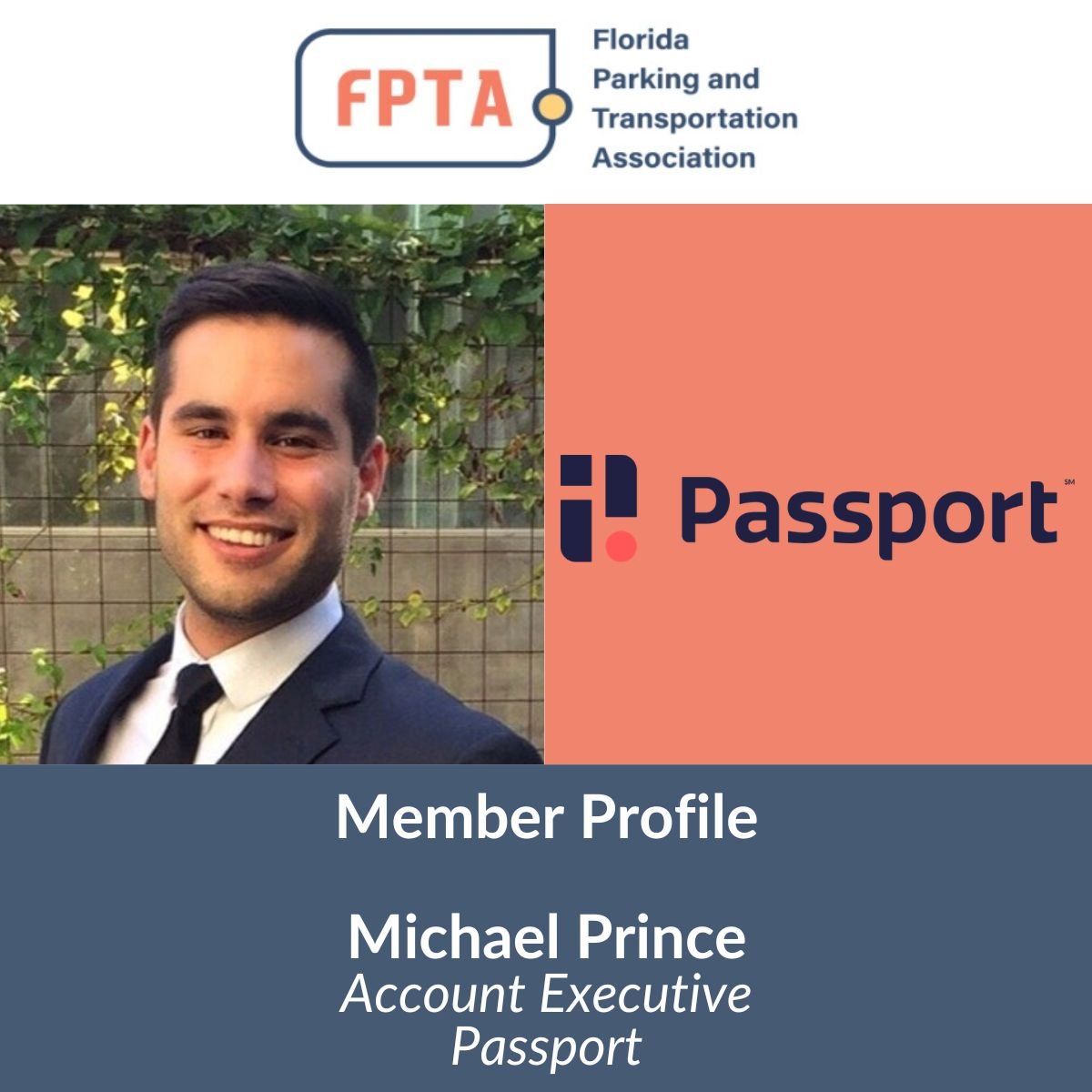
FPTA Member Profile: Michael Prince, Passport
Full Name
Michael Prince
Title
Account Executive III
Organization
Passport
What is your role and how does your organization contribute to parking, transportation, and mobility in Florida?
As an Account Executive at Passport, I help cities, universities, and parking operators across Florida modernize how they manage the curb. Passport's platform unifies parking enforcement, mobile pay parking, permitting, and embedded payments into one centralized system, giving clients better data, more revenue, and a smoother experience for drivers. Passport partners with more than 30 cities and universities statewide — from coastal tourist destinations to major urban centers — connecting communities with technology that makes parking smarter and operations more efficient. My role puts me at the intersection of sales, relationship management, and the future of how people move through their communities.
What drew you to this industry, and what has kept you here?
What drew me in was the opportunity to sell technology that solves a real, visible problem. Everyone has experienced the frustration of parking, and being part of the solution to that is genuinely compelling. What keeps me here is the pace of change. This industry is transforming rapidly — from meters and pay stations to mobile payments, license plate recognition, and data-driven curb management — and I get to be at the forefront of that shift every day. On top of that, it's an incredibly relationship-driven industry. The clients I work with are long-term partners, and helping a city modernize its operations through our solution is a fulfilling experience.
What does a typical day look like in your role?
Every day looks a little different, but at the core, my role is really about being a trusted advisor to the cities and operators I work with. I spend a lot of my time deeply understanding a client's challenges — whether that's compliance issues, revenue leakage, or outdated infrastructure — and then crafting a solution that actually moves the needle for them. My goal is to help community leaders make informed decisions about how their cities function. That's what gets me excited to show up every day — knowing that the work I do has a real impact on how people experience the places they live and visit.
How has being involved with FPTA benefited you or your organization?
Being involved with FPTA has been invaluable — both personally and for Passport as an organization. It's given me a seat at the table with the exact decision-makers and influencers shaping parking and mobility policy across Florida. Those relationships don't just happen overnight, and FPTA has accelerated that trust-building in a way that's hard to replicate through traditional sales outreach.
From an organizational standpoint, it's kept us deeply connected to what's actually happening on the ground in Florida communities — the challenges cities are facing, where policy is heading, and where the industry is going. That intelligence makes us a better partner to our clients.
Being surrounded by peers who are passionate about transforming how cities operate pushes me to think bigger and stay ahead of the curve. FPTA isn't just a networking opportunity — it's where real conversations about the future of our industry happen.
What trends are shaping the future of parking and mobility in Florida right now?
A few things come to mind immediately. First, the shift toward data-driven decision making is massive right now. Cities are moving away from gut-feel policy decisions and demanding real-time insights into how their curbs are being used — that's fundamentally changing how we engage with clients.
Second, the push for unified platforms is accelerating. Florida cities don't want five different vendors managing five different systems. They want one solution that ties together enforcement, payments, permitting, and compliance — and that's exactly where Passport thrives.
Third, there's a growing emphasis on the visitor and resident experience. Florida is a tourism-driven state, and cities are increasingly aware that a frustrating parking experience reflects poorly on the community as a whole. Technology is becoming a hospitality tool, not just an operational one.
And finally, the conversation around curb management is evolving beyond just parking. With the rise of rideshare, delivery vehicles, and micro-mobility, cities are rethinking how every inch of their curb is being used. That's an exciting frontier — and one where I think Florida is going to be a leader in the coming years.
What role do data and analytics play in your decision-making today?
Data is really at the heart of everything we do. When I'm working with a city or operator, the conversation almost always starts with their data (or the lack of it). A lot of municipalities are still making decisions based on outdated information or anecdotal feedback, and part of my role is helping them see what's possible when you have real-time visibility into your operations.
But what I find most compelling is what happens after a city gets onto Passport's platform. They start making smarter policy decisions, deploying enforcement resources more effectively, and identifying revenue opportunities they didn't even know existed. That transformation — from guesswork to confidence — is why we partner with cities. And being able to point to that with real outcomes is what makes the data conversation so powerful in the conversations I have every day.
What makes Florida’s parking and mobility landscape unique compared to other regions?
Florida is genuinely unlike any other market in the country. You have this incredible diversity of communities — from small coastal beach towns managing seasonal tourist surges, to major metros like Miami dealing with dense urban mobility challenges, to college towns balancing resident needs with a transient student population. No two clients look the same.
The seasonality factor is also something you don't see at the same scale elsewhere. A city can go from relatively quiet to completely overwhelmed with visitors in a matter of weeks, and that puts enormous pressure on parking infrastructure and enforcement.
And then there's the sheer pace of growth. Florida is one of the fastest growing states in the country, which means cities are constantly rethinking how they manage people movement at a scale they weren't originally built for. That creates urgency — and cities need forward-thinking partners who understand the complexity of this market.
What’s one strategy or best practice that has made a measurable impact for your organization?
From my time at Passport, it's come down to the difference between adaptation and adoption. A lot of cities make the mistake of buying technology and treating it like a finish line. They adopt a solution, check the box, and move on. But the reality is that the needs of a city are constantly evolving. Policy changes, community demands shift, infrastructure ages, and suddenly that technology that seemed cutting edge two years ago becomes the very thing that's holding them back.
What's made a measurable difference for us is approaching every client relationship as a true partnership. When Passport comes into a city, we're not just deploying software and walking away. We're asking what they need today, but more importantly, where they need to be in three to five years. That forward-looking conversation is what separates adaptation from adoption.
Cities that are simply locked into a vendor — without flexibility, without support, without a platform that grows with them — end up stuck. They can't respond to new policy demands, they can't integrate new technology, and they're essentially being held hostage by a system that was never designed to evolve with them.
Passport's platform is built for adaptation. Whether a city is adding LPR, expanding into permitting, or rethinking how their entire curb is being managed, we're able to grow alongside them. That flexibility, combined with a genuine partnership mentality, is what creates long-term value.
What’s something the industry often overlooks that deserves more attention?
Permitting is often treated as an afterthought, but it's actually foundational to how effective enforcement operates — and it's one of the most frequent touchpoints residents and businesses have with city government. Outdated, manual processes create frustration on both sides, for the citizen and the staff managing it. But beyond the experience, if enforcement officers don't have real-time visibility into who holds a valid permit, they're essentially working blind. That leads to inconsistent enforcement, contested citations, and eroded community trust. Modernizing permitting closes that loop — ensuring compliance is based on accurate, up-to-date information, while improving the overall experience for everyone involved.
Where do you see the parking and mobility industry in the next 5-10 years?
The next five to ten years are going to be transformative for this industry, and I think we're already in the early stages of that shift.
The biggest thing I see is parking infrastructure evolving into true mobility hubs. Parking garages of the future will need EV charging capacity, internet connectivity, and the flexibility to serve multiple purposes beyond just storing cars. That's a fundamental rethinking of what a parking asset actually is.
AI and data are going to be at the center of that transformation. AI-driven automation will reshape everything from real-time occupancy management to seamless, touchless payments — and cities that have already invested in unified platforms will be miles ahead of those that haven't.
For Passport, this is exactly the direction we've been building toward. The work we're doing now — unifying enforcement, payments, permitting, and compliance data — is laying the foundation for what cities are going to need as this industry continues to evolve. I feel really good about where we're positioned.
